Other Species II
Explore Wrokshop
Syllabus⇝
The recent growth of the international DIY-Bio / I-GEM and Bio Hackers networks are born of a motivation to narrow the gulf between research conducted in institutional and corporate settings and to redirect the scientific locus back towards citizen scientists. The agenda of democratizing access to the sciences is shared with that of libre software and open source electronics and maker movements. The course will introduce biological design as a creative and transdisciplinary practice that is open to all. Access to the means of experimentation for the investigative and applied sciences will not only change the way we understand and describe the world but also bring forth new knowledge, designs, and engineering practices. Through the course, researchers will learn how to identify microorganisms, take samples, prepare cultivation media, observe microscopic organisms, and design with DNA.
Learning Objectives⇝
-
Become familiarized with DIY-Bio communities, online knowledge bases as well as practical techniques and resources.
-
Gain an understanding of major and relevant biologically driven design principles and how these can be applied practically to real world problems and emergent solutions.
-
Distinguish between research disciplines including biochemistry / molecular biology / material science and synthetic biology.
-
Attain a capability to differentiate, specify and select relevant researchers and read scientific papers without misunderstanding. Gain proficiency in making proposals in a general way, based on that research.
-Being able to follow the scientific methodology applied to experimentation to generate new knowledge. To plan, execute and extract the proper conclusions from an experiment.
Keywords: DIYbio, Synthetic Biology, Biological Design
Schedule⇝
The following timetable is provisional and may undergo modifications and adaptations during the course.
Day 1 - 9:30-11:30⇝
Theory - Synthetic Biology Theory - Planetary Wellbeing
Day 1 - 11:45-13:30⇝
Practical - Making Petris
Day 2 - 9:30-11:30⇝
Theory - Microbiology + Microbiome
Day 2 - 11:45-13:30⇝
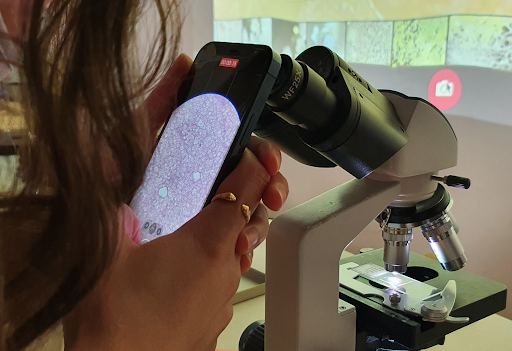
Practical - Microscopy
Day 3 - 9:30-11:30⇝
Theory - Cell Physiology + Genetics
Day 3 - 11:45-13:30⇝
Practical - Liquid culturing - Designing a GMO
Metodological Strategies⇝
- Attendance: Minimum 75% attendance is mandatory.
- Team Participation: Engagement during small team cultivation tasks.
- Knowledge Exchange: Sharing findings from “microbiome mapping”.
- Learning Goals: Scientific method and biological design principles.
- Self-evaluation & Critical Reflection: Documented via the personal blog.
Deliverables⇝
Designed Experiment: A creative depiction (poster, diagram, or infographic) that visualizes a hypothesis and the testing process for a newly conceived GMO.
GitHub Documentation: Reflection on the seminar and class notes uploaded to the personal MDEF repository.
Media Submission: Presentations and videos uploaded to the shared Google Drive folder within one week of the seminar's conclusion.
Creatively depict, describe and visualize a ‘Designed experiment’ that encompasses class concepts, notes and explores the Scientific method and its processes of hypothesizing, developing and testing. The depiction could be in any form of a poster / diagram / info-graphic or any other media. It should creatively depict the impacts of a newly conceived ‘Genetically Modified Organism’ in the world. It may or not may follow an “igem” project presentation.
Bibliography and Background Research Material⇝
TED X Talk : How to convert yourself into a biohacker
Faculty⇝
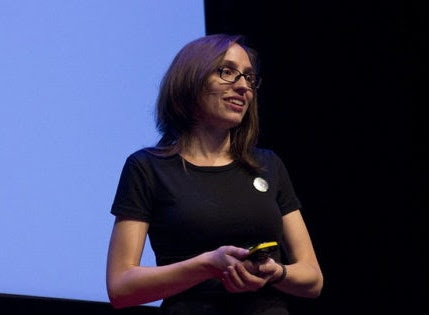
Nuria is a post-doctoral researcher at Complex Systems Laboratory at Universitat Pompeu Fabra (UPF) in the PRBB. She holds a major in Biology and a engineering in informatics and performed her research thesis about Biocomputation, that it is at the interface of both fields. Nuria teaches biology for architects, artist and designers of IAAC, Elisava or Massana universities and is a founder member of the DIYBioBcn, the first biohacking group of Spain.