
Extended Intelligences III
Explore Workshop
Syllabus⇝
Hardware, Software, Wetware
What futures might emerge from a lab-grown brain?
This course, titled "Extended Intelligence III," reframes the concept of intelligence as a hybrid phenomenon. It invites students to explore brain organoids as provocateurs: living, cognitive agents whose unpredictable neural activity challenges how we interpret, frame, and imagine the world around us.
We move beyond the binary of human and machine to explore a synthesis of: - Hardware: Human intelligence — your brains, your intent, and your ethics. - Software: Artificial Intelligence — specifically Large Language Models. - Wetware: Hybrid Intelligence — brain organoids, providing biological unpredictability.
The course is grounded in the "Extended Mind" theory (Clark & Chalmers), but with a critical update for the year 2026. We aim to move beyond the notion of passive tools (like notebooks or smartphones) toward active, biological extensions of the mind.
The objective is to collaboratively produce a Manifesto for a new Extended Mind in the form of a Video Essay.
Students will engage with a pre-designed digital interface developed by Operating System Studio / Umanesimo Artificiale, which connects to Cortical Labs’ proprietary organoid simulator. This interface transforms neural signals into semantic parameters, feeding them into a custom prompt-generation system. This system is powered by an LLM that is trained on all students' inputs and continuously learns from them throughout the workshop.
Keywords: Brain organoids, Organoid Intelligence, Cognitive Interfaces, Data-Driven Fiction, Posthuman Thought
Learning Objectives⇝
- Understand the fundamentals of brain organoids, Organoid Intelligence (OI), and their creative potential.
- Analyze the "Extended Mind" Hypothesis and critically understand the foundational theory of Clark & Chalmers to propose contemporary updates that include biological computing and active agents.
- Explore critical and poetic frameworks for interpreting nonhuman cognition.
- Experience the workflow of moving from individual fragmentation to small group clustering, and finally to a collective class consciousness.
- Synthesize diverse and complex theoretical inputs into a unified public artifact (Video Essay) that communicates a clear vision for the future of intelligence.
Schedule⇝
Week 1 - Day 1**⇝
Theory & Interface - Overview of brain organoids, Organoid Intelligence, and "Extended Mind" theory with case studies. - Introduction to the digital interface designed by Operating System Studio / Umanesimo Artificiale. - Collective brainstorming on Manifesto production.
Week 2 - Day 2
Individual Interaction & Drafting - Each student interacts individually with the interface. They select one specific principle of the Extended Mind that they feel attached to. - Students create raw visual assets (graphics, photos, abstract video clips) that represent this hybrid text.
Week 2 - Day 3
Clustering & Expansion - Students analyze the fragments generated on Day 1 and suggest thematic clusters. - Students divide into groups based on these clusters. - Groups work to expand their specific thematic section and refine their Day 1 visuals into coherent sequences for their specific chapter.
Week 2 - Day 4
Collective Synthesis - The whole class gathers. By this stage, the Class LLM holds the total knowledge of the course (Day 1 Fragments + Day 2 Chapters). - The class inputs collective prompts to stitch the chapters together. - The final text is recorded as a VoiceOver (AI or Human) for the video essay. - Final presentation + open discussion.
Deliverables⇝
- Fragments, Chapters, and Final Output (Video Essay).
- Final presentation + reflection.
Grading Method⇝
| Percentage | Description |
|---|---|
| 20% | Participation |
| 40% | Creative artifacts |
| 30% | Personal reflections |
| 10% | Self-assessment |
European Credit Transfer and Accumulation System (ECTS)
3 ECTS
Material Needs⇝
- Laptops with internet access
- Access to the platform (provided by instructors)
Faculty⇝
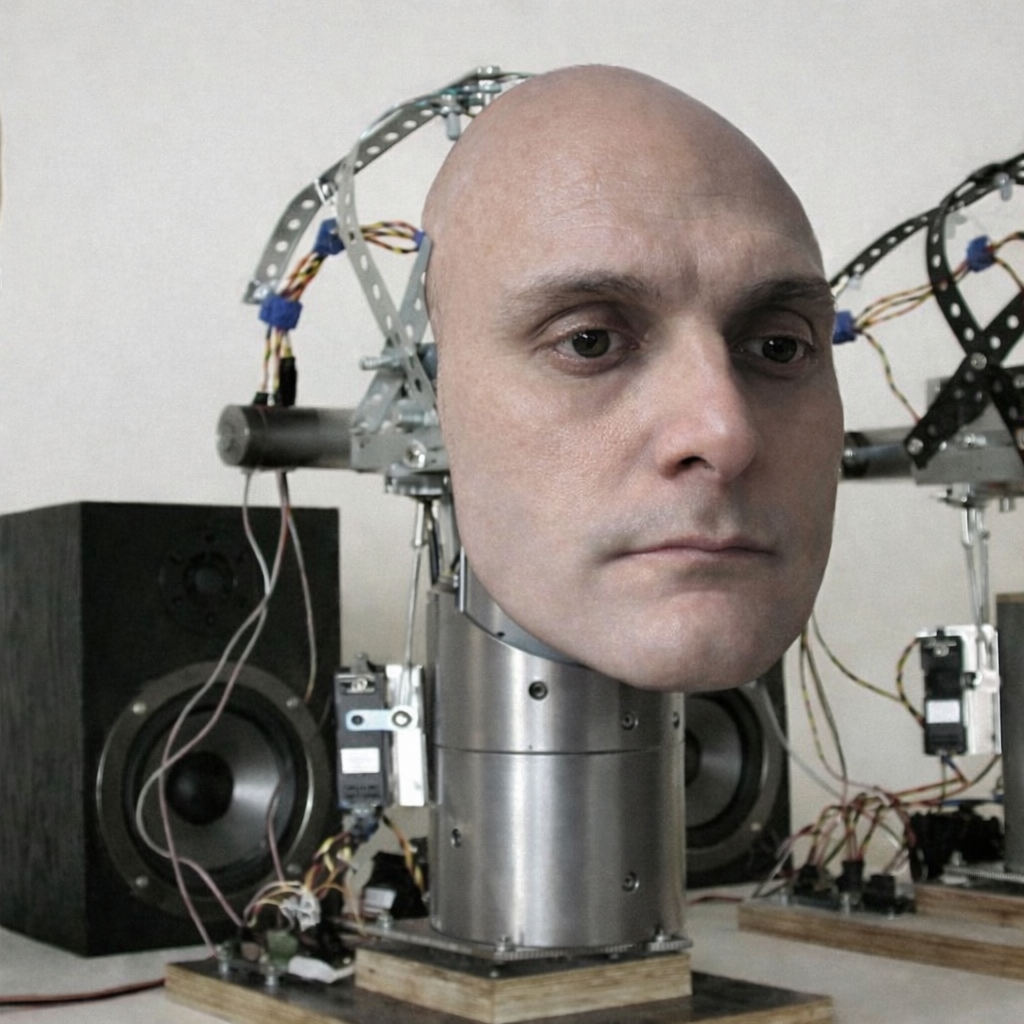
Founder, Creative Director of Umanesimo Artificiale and Operating System Studio Since founding Umanesimo Artificiale in 2017, he has been working across art, science, and exponential technologies. His approach is rooted in antidisciplinarity, exploring the connections between art, design, robotics, biology, and hacking. He maintains a deeply experimental practice, merging artistic and scientific research to foster new forms of creative inquiry and innovation. Umanesimo Artificiale works has been exhibited at Ars Electronica, Sónar Festival, RomaEuropa Festival, Videocittà, RoBot Festival, WeSa Seoul, Benetton Foundation, Embassy of France in Rome (Italy), among others.